

Artificial intelligence has moved from an emerging technology investment to one of the largest areas of capital deployment in the global economy.
Global venture capital investment in AI reached approximately $430 billion in the first half of 2026 alone, already surpassing the total invested throughout 2025. At the same time, hyperscalers continue to pour hundreds of billions into the infrastructure needed to support AI development and deployment. EY estimates that the combination is putting the industry on track for an annual investment run rate approaching $1 trillion.
But the scale of AI investment creates an equally large question: where will the returns come from?
For enterprises, the next phase of AI adoption will increasingly be defined by AI ROI. Moving from pilots to production requires organizations to connect AI implementation to measurable outcomes, whether through lower operating costs, increased capacity, revenue growth or better business performance.
The opportunity is significant. So is the gap between investing in AI and creating value from it.
AI Investment Is Accelerating
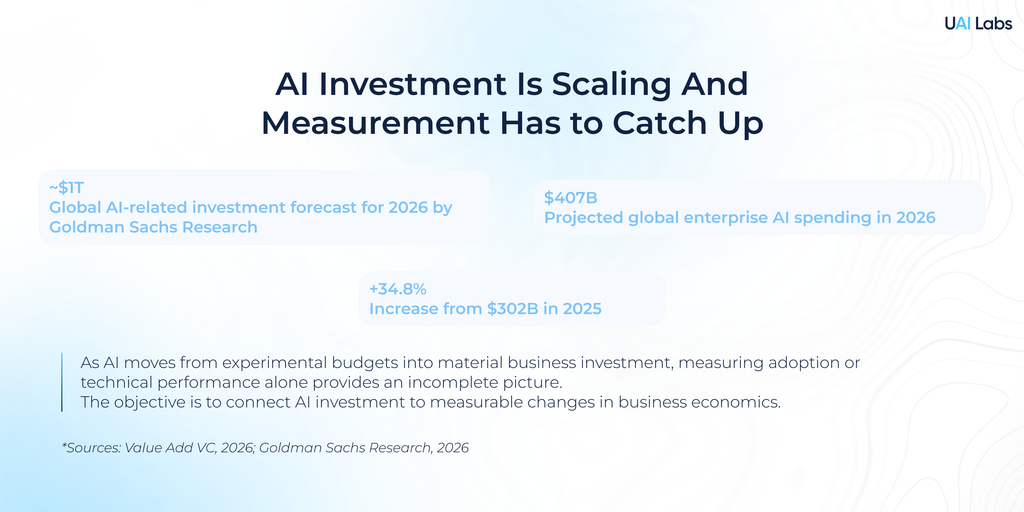
The broader AI spending picture is even larger than the investment figures alone suggest. Gartner forecasts worldwide AI spending will reach $2.7 trillion in 2026, up 49.5% year over year. Infrastructure remains the largest component as hyperscalers and technology providers expand data center capacity, AI-optimized servers, networking and processing capabilities.
Enterprise spending is expanding alongside that infrastructure buildout. AI is increasingly being embedded into existing software, workflows and business processes rather than remaining confined to isolated experiments. Gartner also projects spending on AI models and platforms to grow 63% in 2026, while noting that enterprise AI budgets are facing greater scrutiny around cost, usage and measurable outcomes.
The appetite for investment remains strong. In Deloitte’s survey of 1,854 executives, 85% of organizations reported increasing their AI investment over the previous 12 months, and 91% planned to increase it again.
The direction is clear: more capital is flowing into AI infrastructure, software, models and enterprise implementation. But spending more does not automatically create more business value. As AI investment accelerates, the question is shifting from whether organizations will invest in AI to whether those investments can produce measurable returns.
The AI ROI Gap
Rising investment does not mean that returns are arriving at the same pace. For many organizations, the challenge is no longer gaining access to AI technology but translating its use into measurable business outcomes.
Deloitte’s research illustrates the gap. While 85% of surveyed organizations had increased their AI investment, only 6% reported achieving payback in less than a year. Most organizations expected satisfactory ROI to take two to four years.
Part of the problem is that AI adoption and AI value creation are not the same thing. Deploying an AI assistant, automating an individual task or launching a successful pilot can demonstrate technical capability without showing whether the investment has improved the economics of the business.
The way organizations measure value can make the gap appear even wider. Direct cost savings are relatively easy to quantify, but enterprise AI ROI can also come from increased workforce capacity, shorter cycle times, higher revenue, fewer errors or improved customer outcomes. These benefits require a clear baseline and a connection between the operational change and its financial impact.
As AI moves deeper into enterprise operations, measuring the return on AI investment therefore requires looking beyond adoption rates and technical performance. The more useful question is what changed in the business because AI was implemented.
Where Will AI Returns Actually Come From?
There is no single source of AI ROI. Different use cases create value through different mechanisms, and the same technology can produce very different results depending on where and how it is deployed.
For most businesses, the clearest sources of AI business value fall into four categories.
1. Lower Operating Costs
Automation can reduce the amount of manual work required to complete repetitive, high-volume processes. Document processing, reporting, data entry, information retrieval and routine administrative workflows are obvious examples, but the potential extends across finance, operations, customer service, procurement and other functions.
The economic benefit does not necessarily depend on reducing headcount. If a process requires fewer employee hours, fewer handoffs or less rework, its unit cost can fall even when the size of the team remains unchanged. Reducing errors and avoiding the cost of correcting them can add another source of return.
This makes operational processes particularly useful candidates for measuring AI implementation ROI because organizations can compare cost, time and output before and after implementation.
2. Greater Workforce Capacity
Productivity gains become economically meaningful when the time AI saves is converted into additional useful capacity.
Research increasingly shows that generative AI can reduce the time required for certain knowledge-work tasks. In a field study of more than 5,000 customer support agents, access to a generative AI assistant increased productivity by an average of 14%, with substantially larger gains among less experienced workers.
But time saved is not automatically ROI. If an employee completes a task 30 minutes faster and the released time produces no additional output or other benefit, the financial impact may be limited.
The stronger value chain is:
time saved → capacity released → additional output → measurable business value
That additional capacity might allow a company to process more transactions, serve more customers, complete analysis faster or absorb growth without increasing staffing at the same rate.
3. Revenue Growth
AI ROI can also appear on the revenue side of the equation.
Sales teams can use AI to prioritize opportunities and reduce time spent on administrative work. Customer-facing teams can respond faster and personalize interactions at a greater scale. AI can support recommendations, improve conversion, identify retention risks or enable products and services that would previously have been too expensive or difficult to deliver.
Revenue impact can be harder to attribute than direct cost reduction because multiple factors influence sales and customer behavior. That makes measurement design important. Organizations need to identify which metric the AI implementation is expected to affect, establish a baseline and track whether the change persists after deployment.
For some use cases, even a relatively small improvement in conversion, retention or revenue per customer can produce a larger return than substantial internal time savings.
4. Faster and Better Decision-Making
A significant share of enterprise work involves finding information, combining data from multiple sources, preparing analysis and turning it into a decision. AI can compress that process by accelerating research, reporting, forecasting and information retrieval.
The value, however, is not simply that an answer or report was generated faster. The return comes from what faster access to information enables.
A shorter reporting cycle can allow management to respond to operational problems earlier. Faster analysis can reduce the time required to evaluate an opportunity. Better access to internal knowledge can reduce duplicated work or prevent avoidable errors.
This is also why claims about “better decision-making” need to be tied to observable outcomes. Shorter cycle times, fewer errors, reduced risk, faster execution or improved performance can be measured. The abstract idea of making better decisions cannot.
Across all four categories, the principle is the same: AI value creation begins when a technical improvement produces a measurable operational or financial change.
Why Some AI Investments Will Produce Little or No ROI
As enterprise AI investment grows, not every implementation will generate meaningful returns. In many cases, the problem will not be the technology itself but the way the use case was selected, implemented or measured.
Technology-first projects are particularly vulnerable. Starting with a model or platform and then searching for somewhere to use it can result in technically successful implementations that solve low-value problems. The same applies to pilots that work in isolation but never become part of the workflows employees use every day.
Other barriers are operational. Poor data quality can limit the reliability of an AI system. Lack of integration can create additional steps instead of removing them. Low adoption can leave a technically capable solution underused. And without a baseline for cost, time, output or performance, organizations may have no reliable way to determine whether implementation created value at all.
This is why the number of AI tools deployed, employees with access or pilots completed says relatively little about AI ROI.
A successful implementation needs a clear connection between the business problem, the AI use case and the outcome being measured. Otherwise, organizations risk accumulating AI capabilities without creating corresponding business value.
Measuring AI ROI Requires More Than Tracking Cost Savings
Calculating the return on AI investment starts with understanding both sides of the equation. The investment extends beyond the price of a model or software license. Depending on the use case, organizations may also need to account for implementation, integration, infrastructure, data preparation, employee training, governance and ongoing operating costs.
The return can be equally broad. It may include:
- lower operating and processing costs;
- additional workforce capacity;
- increased revenue or conversion;
- avoided costs and reduced errors;
- shorter cycle times;
- improved customer retention or service performance.
The appropriate metrics depend on the problem the AI implementation was designed to solve.
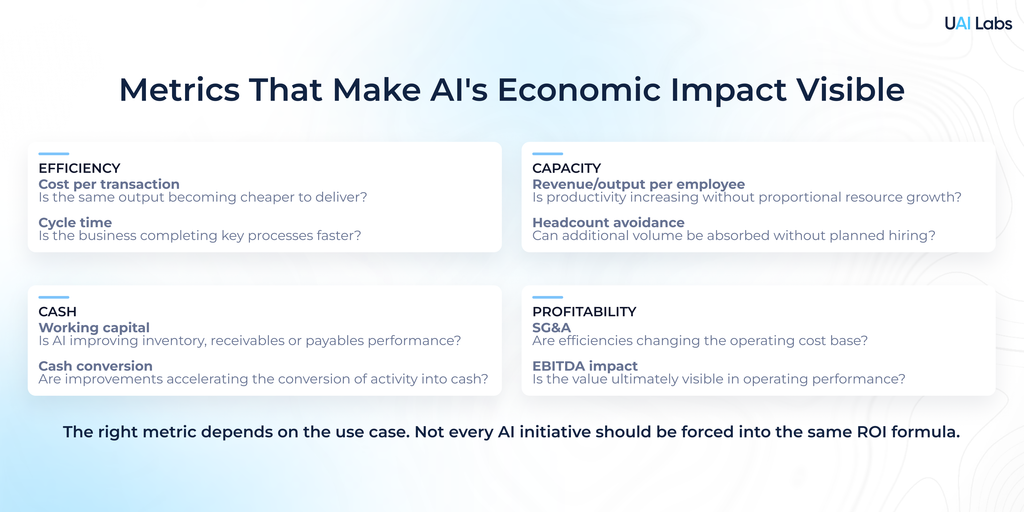
Consider an AI system that reduces invoice processing time from 12 minutes to four. The eight minutes saved demonstrates an operational improvement, but it does not yet establish the financial return. The organization still needs to know how many invoices are processed, the cost of the employees performing the work, whether error rates changed and how the released capacity is being used.
This is why measuring AI ROI should begin before implementation rather than after it. Establishing a baseline makes it possible to compare performance and determine whether an observed improvement can translate into economic value.
It also prevents productivity metrics from becoming proxies for ROI. Hours saved, faster outputs and higher adoption can all be useful indicators, but they are intermediate results. Their financial value depends on what happens next.
For enterprise AI ROI, the strongest measurement frameworks connect three levels:
AI capability → operational change → business outcome
A system might automate a task, which reduces processing time, which increases capacity and lowers the cost per transaction. Another might improve access to customer information, which enables faster responses and ultimately improves retention.
Following that chain makes it easier to distinguish genuine AI value creation from activity that simply demonstrates that the technology is being used.
The Next Phase of AI Investment Is About Value Creation
AI investment is unlikely to slow simply because measuring returns is difficult. Infrastructure is expanding, AI capabilities are becoming embedded across enterprise software, and organizations continue to increase their budgets.
But as spending grows, the standard for success is changing. The first phase of enterprise AI was dominated by experimentation: testing models, launching pilots and identifying what the technology could do. The next phase will increasingly focus on what those capabilities are worth.
That means connecting AI implementation to the economics of the business. Lower operating costs, greater capacity, revenue growth, shorter cycle times and improved performance provide measurable paths to return. Pilots and adoption metrics alone do not.
As AI investment moves toward unprecedented levels, the important question is no longer simply how much organizations are spending on AI. It is how effectively they can turn that investment into measurable business value.