

The EU AI Act is no longer a distant regulatory headline. Key obligations are already in force, and compliance has shifted from theory to practice. For enterprises, this means governance, documentation, and deployment controls are not optional add‑ons — they are now part of the operating model itself.
The message is clear: firms that embed compliance early will scale faster and avoid costly remediation later. Treating the EU AI Act as a real operating constraint, rather than a future concern, is the only way to stay competitive in Europe’s evolving regulatory landscape.
Timeline of Implementation
The European Commission’s phased rollout confirms that obligations are arriving in waves, each with direct impact on enterprise operations:
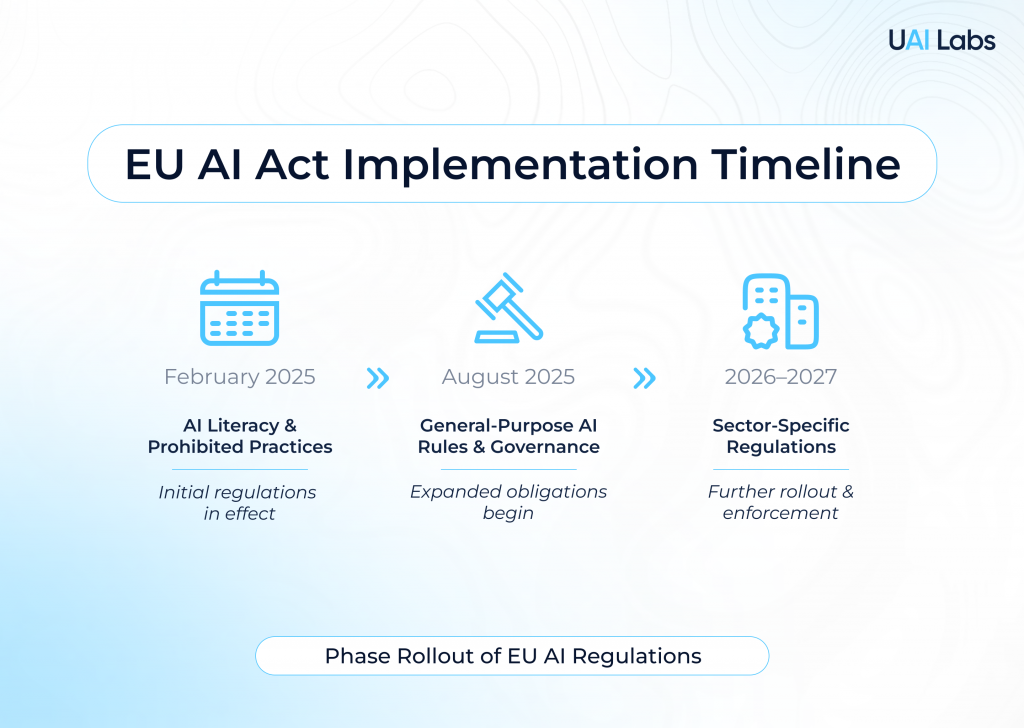
- February 2025 → AI literacy and prohibited‑practice rules began applying. This includes bans on manipulative or exploitative AI use cases, alongside requirements for basic organizational AI literacy.
- August 2025 → General‑purpose AI rules and governance obligations came into effect. Providers must now address transparency, copyright, and safety/security requirements, supported by the Commission’s General‑Purpose AI Code of Practice.
- 2026–2027 → Further rollout continues, extending obligations to sector‑specific applications and expanding governance requirements across industries.
This phased approach means enterprises can’t wait until 2027 to act. Compliance is already shaping how AI systems are designed, documented, and deployed. The firms that treat governance as infrastructure — not paperwork — will be positioned to scale AI responsibly and efficiently.
What Compliance Means in Practice
The EU AI Act is not just about legal text. It translates directly into operational requirements that enterprises must embed into their delivery models.
- Governance: Clear ownership of AI systems is essential. Firms need defined accountability structures so that responsibility for compliance is not scattered across departments.
- Documentation: Every stage of the AI lifecycle must be recorded — from design choices to testing outcomes. This ensures transparency and provides evidence if regulators request audits.
- Deployment Controls: Release processes must include validation steps, risk checks, and approval gates. Without these, firms risk deploying systems that violate prohibited practices.
- Monitoring: Compliance does not end at deployment. Continuous monitoring of AI systems is required to catch drift, bias, or misuse before they escalate.
The practical reality is that compliance cannot be bolted on after launch. It has to be part of the delivery architecture from the start. Enterprises that treat governance as infrastructure will find scaling easier and remediation costs lower.
Impact on Portfolio Companies
For portfolio companies, the implications are straightforward. AI systems are entering core workflows, and compliance must follow them in.
- CFOs need to ensure that financial reporting and risk management processes include AI governance. Documentation and audit trails are not optional — they are part of fiduciary responsibility.
- CIOs must integrate compliance into technology roadmaps. This means embedding testing, release controls, and monitoring into enterprise systems rather than treating them as side projects.
- Private Equity firms face portfolio‑wide exposure. A single company’s compliance failure can create reputational risk across the entire portfolio.
The opportunity is clear: firms that embed compliance early can use it as a differentiator. In exit scenarios, buyers will value companies that demonstrate structured governance and reduced regulatory risk. Conversely, those that delay will face remediation costs, stalled scaling, and weaker valuations.
Common Pitfalls Enterprises Face
Many companies approach EU AI Act compliance with good intentions but fall into predictable traps. One of the most common mistakes is treating compliance as a paperwork exercise. Firms produce documentation for the sake of audits but fail to embed governance into the way systems are actually designed and deployed. This creates a false sense of security and leaves operational risks unaddressed.
Another pitfall is waiting until deployment to add governance. By the time an AI system is live, retrofitting controls is expensive and disruptive. Remediation often requires halting workflows, rewriting code, or re‑training models — all of which slow down scaling and erode trust with stakeholders.
Documentation requirements are also frequently underestimated. The Act demands clarity across the entire lifecycle, from design decisions to testing outcomes. Enterprises that neglect this level of detail struggle when regulators request evidence, and they often discover gaps only after an audit is underway.
Finally, many organizations continue to rely on uncontrolled pilot projects. Pilots can be useful for experimentation, but without structured delivery models they create sprawl. Systems proliferate without ownership, governance, or monitoring, leaving firms exposed to compliance failures and inconsistent performance.
Practical Roadmap for Enterprises
Compliance under the EU AI Act can feel abstract until it is translated into concrete steps. Enterprises that want to move quickly while staying within regulatory boundaries should treat compliance as part of their delivery architecture.
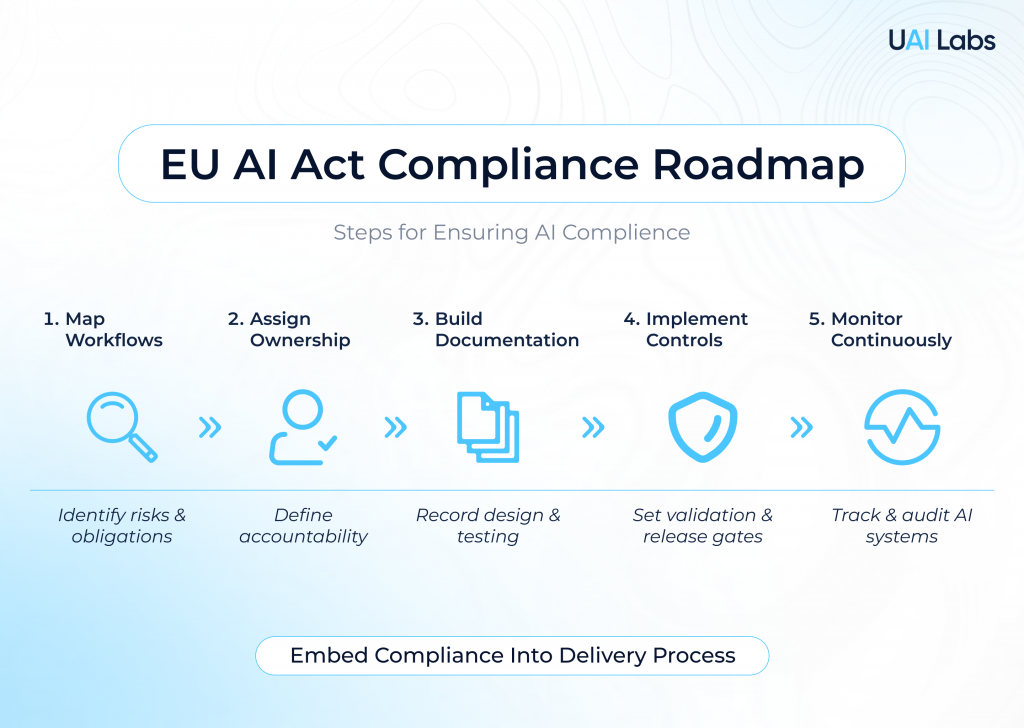
The first step is mapping workflows against obligations. Firms need to identify where AI systems intersect with prohibited practices, transparency requirements, or governance rules. Once those intersections are clear, ownership must be assigned. Accountability cannot be left vague; every system should have a responsible owner who ensures documentation and testing are completed.
Documentation itself should be embedded into delivery cycles. Instead of producing reports after deployment, firms should capture design decisions, validation results, and monitoring data as part of the process. Release controls then act as checkpoints, ensuring that systems are not deployed without passing compliance gates. Finally, monitoring must be continuous. Drift, bias, or misuse can emerge over time, and ongoing oversight is the only way to maintain compliance.
When enterprises follow this roadmap, compliance becomes infrastructure rather than overhead. It reduces remediation risk, accelerates scaling, and builds trust with regulators and stakeholders. To make compliance more tangible, enterprises can also use the EU AI Act Compliance Checker, an interactive tool provided by the European Commission. It helps organizations assess whether their AI systems fall under the Act’s obligations and what specific requirements apply.
UAI Labs Perspective
The EU AI Act makes one point unavoidable: governance cannot be treated as an afterthought. For enterprises and portfolio companies, compliance has to be embedded into the operating model from the start. This is exactly where UAI Labs places its emphasis.
Rather than relying on ad‑hoc pilots or fragmented delivery, UAI Labs builds structured frameworks that align with regulatory expectations while keeping scaling practical. Our proprietary products — Beacon, Compass, Navigator, and Voyager — are designed to help firms move beyond experimentation and into disciplined execution. Each framework addresses a different layer of the challenge.
For CFOs and CIOs, this approach means compliance is not a burden layered on top of operations but part of the delivery architecture itself. By embedding governance, documentation, and monitoring into the operating model, firms reduce remediation risk and create a foundation for scaling agentic AI responsibly under the EU AI Act.
Looking Ahead
The EU AI Act is still rolling out, with sector‑specific rules and expanded obligations continuing toward 2027. But the direction is already clear: compliance will become a baseline expectation, not a differentiator. Firms that embed governance early will find themselves ahead of the curve, able to scale agentic AI responsibly while competitors struggle with remediation.
For portfolio companies, this is not just about avoiding penalties. It is about building resilience and credibility in a market where regulatory literacy is becoming a core requirement. By treating compliance as part of the operating model, enterprises can move beyond pilot sprawl and into disciplined, scalable adoption.
The takeaway is simple. The EU AI Act is no longer a distant headline. It is an operating constraint that shapes how AI systems are designed, deployed, and monitored. Enterprises that act now will not only meet regulatory obligations but also position themselves to lead in the next phase of AI adoption.