

Agentic AI has quickly shifted from a buzzword to a tangible force reshaping enterprise operations. Unlike traditional AI models that focus on prediction or classification, agentic AI emphasizes autonomous decision‑making and workflow execution. This distinction matters: enterprises aren’t just experimenting with smarter algorithms, they’re testing systems that can act, adapt, and deliver outcomes with minimal human intervention.
Yet despite the hype, the reality is sobering. Most organizations remain stuck in pilot projects, unable to bridge the gap between experimentation and scaled deployment. Reports from McKinsey and OpenAI highlight the same trend: adoption is accelerating, but scaling remains elusive. For enterprises, this isn’t just a technical challenge — it’s a strategic one. The question is no longer “Can we build agents?” but “How do we embed them into the fabric of our operations?”
The Acceleration of Agentic AI
The pace of agentic AI adoption is undeniable. In just a few years, enterprises have moved from curiosity to widespread experimentation. McKinsey’s 2025 global AI survey found that nearly two‑thirds of companies have tested agentic systems, while OpenAI’s enterprise report shows deeper workflow integration across industries.
Several factors explain this acceleration:
- Maturity of AI platforms: Tools like GPT‑based agents and specialized orchestration frameworks have lowered the barrier to entry.
- Pressure for efficiency: Economic uncertainty has pushed enterprises to seek automation that delivers measurable ROI.
- Cultural shift: Executives increasingly view AI not as a side project but as a core enabler of competitiveness.
Early adopters are already embedding agentic AI into areas like supply chain management, customer support, and compliance monitoring. These use cases demonstrate that when agents are connected to real workflows, they can reduce costs, improve speed, and unlock new value streams.
Still, acceleration doesn’t equal scale. The majority of enterprises remain in the “sandbox” phase — experimenting with agents in isolated environments without the infrastructure to support enterprise‑wide deployment. This is where the adoption curve stalls, and where the next section will dig into why scaling lags behind.
Why Scaling Still Lags Behind
Despite the surge in experimentation, scaling agentic AI across an enterprise remains the exception rather than the rule. McKinsey’s 2025 survey revealed that while nearly two‑thirds of organizations have tested AI agents, fewer than 10% have achieved meaningful scale. OpenAI’s enterprise report echoes this: adoption is rising, but most deployments remain siloed, limited to small pilots or departmental experiments.
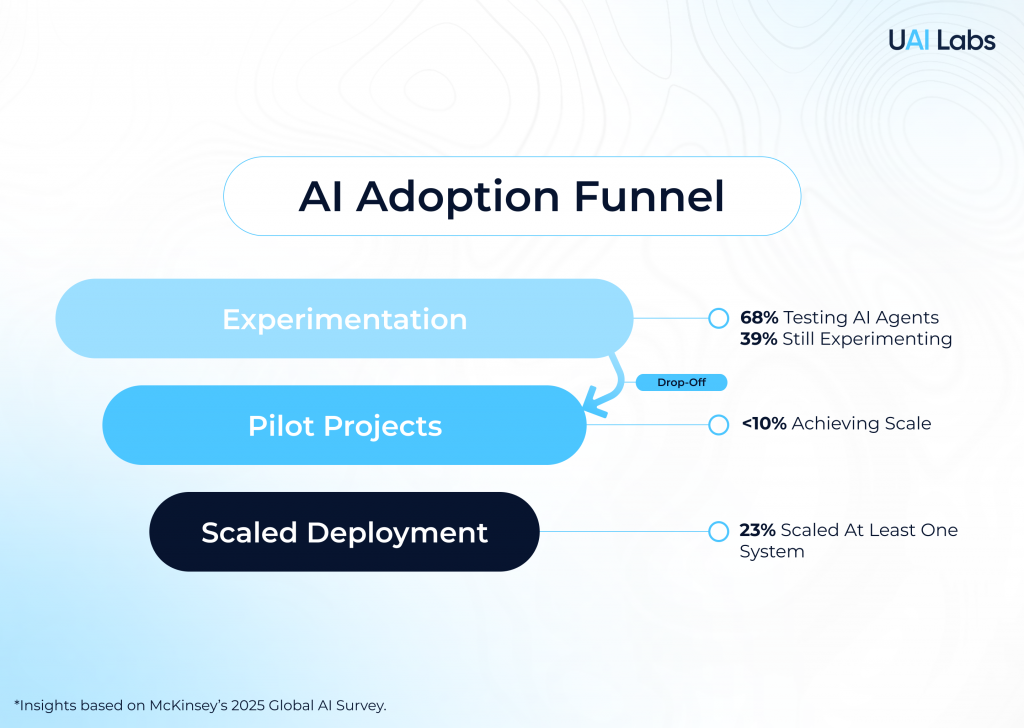
The reasons are multifaceted:
- Infrastructure gaps: Many enterprises lack the technical backbone to support agentic workflows at scale. Legacy systems and fragmented data architectures make integration difficult.
- Governance concerns: Executives hesitate to expand pilots without clear frameworks for security, compliance, and accountability.
- Talent shortages: Skilled teams capable of designing, deploying, and maintaining agentic systems are still scarce.
- ROI uncertainty: Without clear metrics, leaders struggle to justify scaling beyond experimentation.
This lag creates a widening gap between innovators and laggards. Companies that move past pilots are already reaping efficiency gains, while those stuck in experimentation risk falling behind in competitiveness.
Common Barriers Enterprises Face
Scaling agentic AI isn’t just about technology — it’s about organizational readiness. Enterprises encounter recurring barriers that stall progress:
- Fragmented processes: Workflows often span multiple departments and tools, making it difficult for agents to operate seamlessly.
- Manual coordination: Human‑driven checkpoints slow down automation, preventing agents from delivering end‑to‑end outcomes.
- Disconnected systems: Without unified data pipelines, agents struggle to access the information needed to act effectively.
- Duplicated validation: Enterprises often require redundant approvals, which undermines the autonomy that agentic AI is designed to provide.
Industry examples highlight these challenges:
- Finance: Compliance requirements demand rigorous oversight, slowing down agentic deployment.
- Healthcare: Sensitive patient data creates integration hurdles, requiring strict governance before scaling.
- Supply chain: Legacy ERP systems limit interoperability, making agentic workflows harder to embed.
These barriers explain why so many enterprises remain in the “sandbox” stage. Overcoming them requires not just technical fixes but cultural and structural shifts — treating agentic AI as infrastructure rather than an experiment.
Lessons from Early Success Stories
While most enterprises remain stuck in pilot mode, a handful of organizations have successfully scaled agentic AI — and their results are instructive.
Supply Chain Optimization: Companies that embedded agentic AI into logistics workflows reported double‑digit improvements in delivery speed and inventory accuracy. Agents can autonomously reroute shipments, adjust procurement schedules, and flag bottlenecks before they escalate.
Customer Service Automation: Enterprises deploying agentic AI in support centers have reduced average handling times and improved customer satisfaction scores. Agents don’t just answer queries; they escalate intelligently, learn from past interactions, and personalize responses at scale.
Risk Management in Finance: Banks experimenting with agentic AI for fraud detection have seen faster anomaly detection and reduced false positives. By integrating agents into transaction monitoring, they’ve cut operational costs while strengthening compliance.
These examples highlight a critical point: agentic AI delivers measurable ROI when it’s tied to real workflows. Success stories aren’t about flashy pilots; they’re about embedding agents into the operational backbone where efficiency gains translate directly into business outcomes.
From Pilots to Infrastructure
The transition from pilot projects to enterprise infrastructure is the defining challenge of agentic AI adoption. Treating agents as “tools” limits their potential; treating them as infrastructure unlocks scale.
Three pillars underpin this shift:
- Governance: Enterprises must establish clear rules for agent autonomy, accountability, and compliance. Without governance, scaling risks spiraling into chaos.
- Security: Agentic workflows often touch sensitive data. Secure integration, access controls, and monitoring are non‑negotiable for enterprise trust.
- Scalability: Pilots can run on isolated systems, but enterprise‑wide deployment requires robust architectures — unified data pipelines, orchestration layers, and monitoring dashboards.
Forward‑thinking organizations are already building “agentic operating systems” that treat AI agents as core infrastructure. This mindset reframes the question from “Can we test agents?” to “Which workflows should we prioritize for agentification, and how do we scale them securely?”
Enterprises that make this leap position themselves for long‑term advantage. Agentic AI isn’t just another software upgrade; it’s a structural transformation of how work gets done.
The Role of UAI Labs in Scaling Agentic AI
For Private Equity firms and their portfolio companies, the challenge isn’t testing agents — it’s scaling them into reliable, enterprise‑grade workflows. This is where UAI Labs steps in. Our focus is not on one‑off experiments but on building operating models that make agentic AI sustainable, measurable, and secure.
What sets UAI Labs apart is that we don’t just consult — we develop and deploy our own tested frameworks:
- Beacon: A foundation for agentic AI adoption, aligning enterprise workflows with automation opportunities.
- Compass: A diagnostic layer that identifies which processes are most ready for agentification, ensuring investments are sequenced for maximum impact.
- Navigator: An orchestration system that integrates agents into existing enterprise infrastructure, reducing friction and accelerating execution.
- Voyager: A scaling framework designed to extend agentic workflows across multiple portfolio companies, creating consistency without reinventing the wheel.
By combining evidence‑driven diagnostics with portfolio‑scale playbooks, UAI Labs helps firms move beyond pilots and into measurable transformation.
Our approach is simple but powerful: prioritize the right workflows, embed agents securely, and scale them across operations with a stable model. In doing so, we bridge the gap between experimentation and enterprise value, positioning Private Equity firms to unlock efficiency and growth across their portfolios.
Practical Steps for Enterprises Ready to Scale
The path from pilot projects to enterprise‑wide agentic AI doesn’t have to be abstract. It can be broken down into practical, actionable steps:
- Identify high‑impact workflows
Focus on processes that are repetitive, data‑heavy, and directly tied to measurable outcomes. Finance reconciliation, supply chain logistics, and compliance monitoring are prime candidates.
- Design agentic models with governance in mind
Build agents that operate within clear guardrails. Define escalation paths, accountability structures, and compliance checks from the start.
- Secure integration with existing systems
Agents must plug into ERP, CRM, and data pipelines without creating silos. Prioritize interoperability and security controls.
- Measure ROI continuously
Don’t wait until full deployment to assess value. Track efficiency gains, cost reductions, and risk mitigation at each stage of scaling.
- Iterate and expand
Treat scaling as a phased rollout. Start with one workflow, prove value, then extend across departments and portfolio companies.
This roadmap reframes agentic AI as a disciplined scaling exercise rather than a risky leap. Enterprises that follow these steps can move beyond experimentation and embed agents into the operational backbone with confidence.
Looking Ahead: The Future of Agentic AI in Enterprises
Agentic AI is not a passing trend — it’s the next layer of enterprise infrastructure. Over the coming years, several shifts are likely to define its trajectory:
- Deeper integration: Agents will move from isolated pilots into cross‑system orchestration, managing workflows that span finance, operations, and customer engagement.
- Portfolio‑wide adoption: Private Equity firms will increasingly deploy agentic AI across multiple portfolio companies, creating standardized efficiencies at scale.
- AI as default infrastructure: Just as cloud computing became the backbone of modern IT, agentic AI will become the backbone of enterprise automation.
- Competitive differentiation: Organizations that embed agents deeply will pull ahead, not just in efficiency but in agility — responding faster to market shifts and regulatory changes.
The message is clear: enterprises that treat agentic AI as infrastructure, not experimentation, will define the next era of operational excellence. Those that hesitate risk being left behind as automation becomes the baseline expectation.