

AI adoption in finance is emerging as the first serious profit pool for artificial intelligence. What was once curiosity is now turning into budget commitments. Bain’s latest research shows that more than half of CFOs are increasing AI investment by over 15% this year, yet only 15%–25% have fully scaled AI across finance functions. That mismatch matters: investment is rising, but the value gap between pilots and scaled deployment remains wide.
This tension is central to understanding AI in finance value creation. Finance is not just another function experimenting with automation; it is the domain where measurable outcomes connect directly to board‑level metrics. The shift from pilots to scaled workflows is where AI stops being “interesting” and starts being visible in the numbers.
The Investment–Scaling Gap
AI budgets in finance are rising fast, but scaled adoption remains limited. Bain’s research shows that while more than half of CFOs are increasing AI investment by over 15%, only 15%–25% have fully scaled AI across finance functions. This gap highlights a critical tension: enterprises are spending, yet the returns are not consistently visible in financial outcomes.
The reason is straightforward. Pilots often demonstrate potential but fail to embed AI into the workflows that matter most. Without integration into forecasting, reporting, or working‑capital visibility, AI remains a side project rather than a driver of measurable value. Closing this investment–scaling gap is the key to unlocking finance as the first serious AI profit pool.
Why Finance Matters for PE‑Backed Transformation
Finance is uniquely positioned at the center of enterprise discipline. It touches planning, reporting, SG&A control, and working‑capital visibility — all areas where private equity firms demand measurable improvement. Bain’s latest finance research emphasizes that the biggest gains do not come from isolated AI tasks, but from embedding AI into repeatable, decision‑rich workflows.
For PE‑backed companies, this matters because finance is where AI can directly influence board‑level metrics. Embedding AI into variance analysis, cash‑flow forecasting, and SG&A tracking creates transparency and accountability. It turns AI from a technical experiment into a governance tool that supports transformation. In this way, finance becomes the proving ground for AI in value creation, showing investors and executives that adoption can move beyond pilots and into disciplined execution.
Why Finance Is the Proving Ground
- Direct link to board metrics: Finance connects AI adoption to EBITDA, cash flow, and SG&A discipline — the numbers investors care about most.
- Repeatable workflows: Unlike one‑off pilots, finance processes (forecasting, reporting, variance analysis) run continuously, making them ideal for scaled AI integration.
- Governance and accountability: AI in finance enforces transparency, ensuring that portfolio companies can demonstrate measurable improvements to PE boards. This aligns with broader regulatory expectations such as the EU AI Act, which emphasizes documentation, risk management, and governance as part of responsible AI adoption.
- Cross‑functional influence: Finance data flows into operations, procurement, and strategy, meaning AI improvements here ripple across the enterprise.
- Investor confidence: Demonstrating AI value in finance reassures PE firms that adoption is not just experimental but embedded in the operating model.
By embedding AI into finance, PE‑backed companies show that adoption can move beyond pilots and into disciplined execution. Finance becomes the proving ground for AI in value creation, setting the precedent for how other functions will follow.
From Curiosity to Value Creation
Finance is often the first function where AI moves from “interesting” experiments to measurable impact. Pilots in forecasting or variance analysis may show promise, but the real shift happens when AI is embedded into workflows that directly influence board‑level metrics.
The difference between pilots and scaled adoption is visibility. A pilot might improve one report or automate a single reconciliation, but scaled AI changes the rhythm of finance. It reduces forecasting errors across the enterprise, accelerates monthly close cycles, and strengthens working‑capital visibility. These improvements are not abstract — they show up in EBITDA, liquidity, and operational discipline.
Consider three practical areas where AI in finance creates visible value:
- Cash‑flow forecasting: AI models can integrate real‑time sales, procurement, and treasury data, reducing variance and giving CFOs sharper visibility into liquidity.
- Working‑capital management: By analyzing payment patterns and supplier behavior, AI highlights bottlenecks and opportunities to free up cash, directly improving balance‑sheet health.
- SG&A discipline: AI can track spending trends across departments, flag anomalies, and support cost‑control initiatives that boards expect in PE‑backed environments.
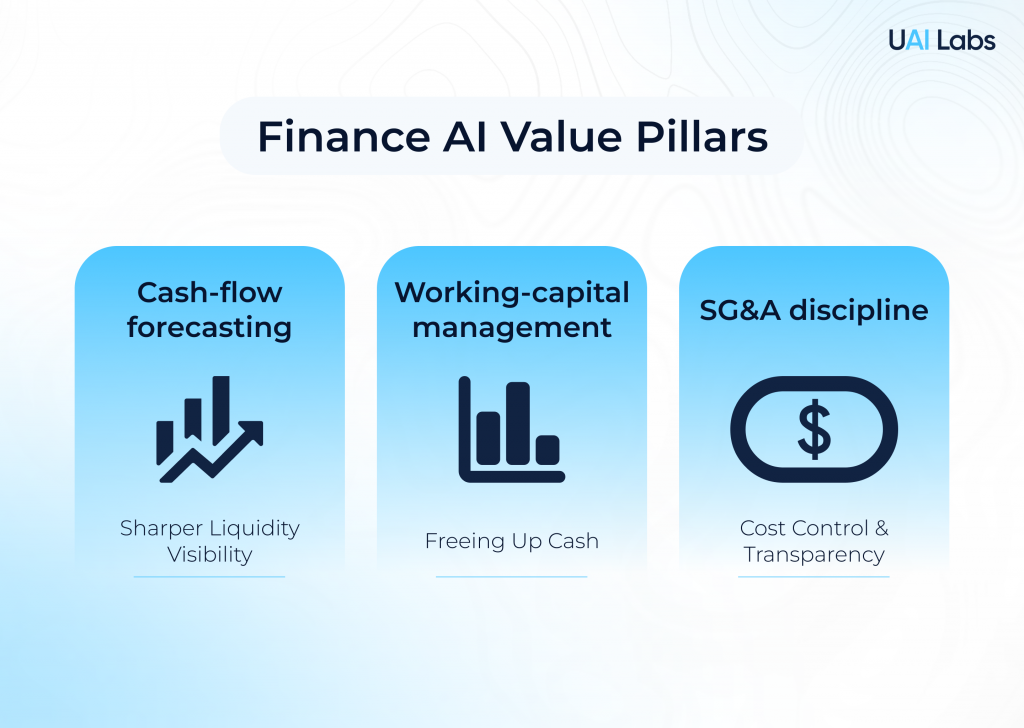
The impact is cumulative. When forecasting becomes more accurate, reporting cycles faster, and SG&A more disciplined, finance shifts from being a support function to a profit pool. AI adoption here is not about novelty — it is about embedding intelligence into decision‑rich workflows that drive measurable outcomes.
This is why finance becomes the proving ground for AI in value creation. It is the first domain where executives and investors can see AI move from curiosity to numbers that matter, setting the precedent for how other functions will follow.
UAI Labs Perspective
At UAI Labs, finance maps naturally into the value‑creation lens. The approach begins with identifying where friction in finance is measurable, then connecting those use cases to board‑level metrics. From there, execution runs through a governed delivery model designed to scale responsibly.
Our frameworks — Beacon, Compass, Navigator, and Voyager — are built to move enterprises beyond pilots. They embed governance, documentation, and monitoring into delivery cycles, ensuring that AI adoption in finance is not only compliant but also scalable. For CFOs and PE firms, this means AI becomes part of the operating model rather than a series of disconnected experiments.
Finance is often the first domain where AI adoption can demonstrate visible returns. By embedding AI into decision‑rich workflows, enterprises can close the investment–scaling gap and establish finance as the first serious AI profit pool.
Looking Ahead
Finance is becoming the first serious AI profit pool because it connects directly to measurable outcomes. CFOs and PE firms are no longer experimenting at the edges; they are embedding AI into the workflows that shape liquidity, reporting accuracy, and SG&A discipline. The investment–scaling gap will not close through pilots alone — it requires governed delivery models that make AI part of the operating rhythm.
For enterprises, this means finance is the proving ground. Success here demonstrates that AI adoption can move beyond curiosity and into visible value creation. As AI in finance becomes embedded, it sets the precedent for other functions to follow, showing investors and boards that disciplined scaling is possible.
The takeaway is clear: finance is not just another function adopting AI. It is the domain where AI’s economic value becomes visible first, making it the foundation for broader enterprise transformation.